Research
Predicting Exoplanet Survey yields with TIaRA

During my MSc by research at the University of Warwick, I developed the Transit Investigation and Recoverability Application (TIaRA). TIaRA is a tool which can measure the sensitivity of photometric data to exoplanets of different radii and orbital period. We can then combine this sensitivity information with calculated occurrence rates to estimate yields of planet discoveries. I have already led one study using TIaRA to predict yields for the TESS mission (Rodel et al., 2024) with plans for followup studies both using additional TESS data and applying TIaRA to other surveys. TIaRA was also used to determine detection sensitivities of known multiplanet host stars in both TESS and PLATO by Eschen et al., (2024).
Long period transiting Planets
One of the most remarkable results from the first TESS yield prediction I made with TIaRA was the lack of detected planets at long periods compared to our predictions. This led us to believe that there was a wealth of undiscovered long-period transiting planets hiding in the TESS data, most with only one or two transit detections. I have since become involved with the NGTS long-period planet working group which aims to discover these hidden long-period planets in TESS data. One of my recent successes was the discovery of NGTS-38 b, a warm super-Jupiter on a 180 day period orbit which we published in Rodel et al., (2026)
Low Mass Eclipsing Binaries (EBLMs)
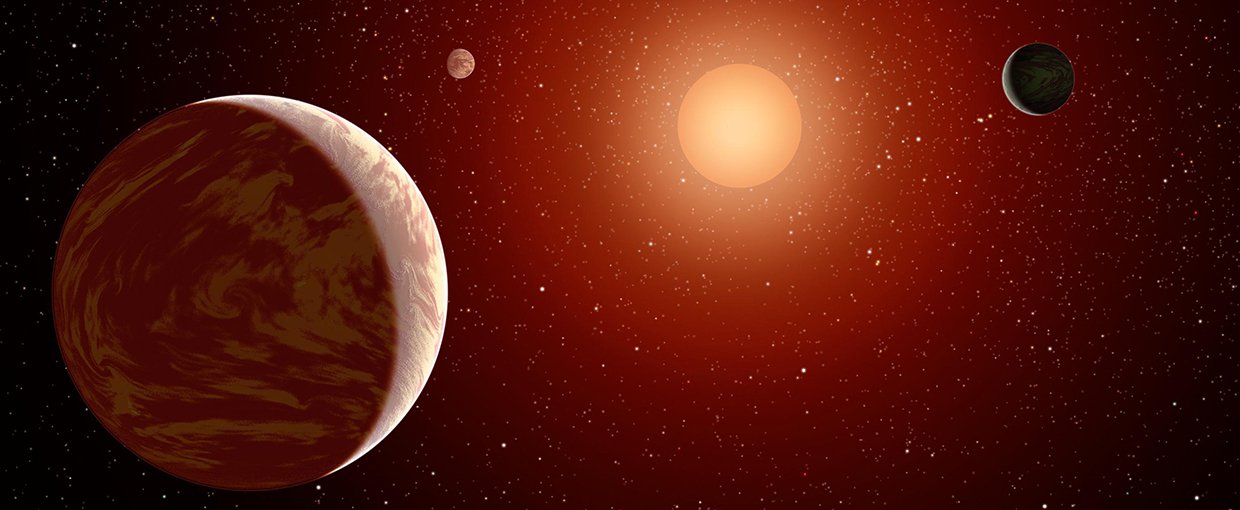
My recent work has included efforts to discover and characterise eclipsing binaries where one or more components are low mass stars belonging to spectral type M or later. These systems are often just seen as a source of false positives in exoplanet surveys but represent an interesting class of object in themselves. Despite being the most common in the universe, these stars are poorly understood on account of their inherent faintness. By studying these stars in eclipsing binaries we can gain a better understanding of their fundamental properties. This, in turn, allows us to better understand the rocky Earth-sized exoplanets which are known to orbit many of these stars, such as the remarkable TRAPPIST-1 system.
My recent first author publication Rodel., et al. (2025) describes the discovery and characterisation of NGTS-EB-7 which is one of the longest-period and most eccentric EBLM systems known. The exceptional distance between the two stars makes it a strong benchmark for testing models of stellar evolution and understanding the inflated radii of many low mass stars in closer binaries.
